Behind the $10,000 USD prize is a rigorous, transparent process that ensures only the best startups reach the final stage.
Anyone can hold a startup exhibition. What separates SEE Pakistan 2026 from the rest is not the prize money or the venue. It is the process that decides who gets there.
The WSC-SEE Pakistan evaluation system is one of the most structured and transparent in Pakistan’s startup ecosystem. It has multiple stages. It filters out weak entries early. It trains participants before judging them. And it puts every finalist in front of a panel of credible experts who score against clearly defined criteria.
This blog explains that process — from the first application to the final prize.
Stage 1: Open Applications — National and International
The process begins with an open call. Applications are collected through national and international platforms, making SEE Pakistan accessible to startups from across Pakistan and beyond (SEE Pakistan, 2026).
Once the deadline closes, the submitted data will be carefully reviewed. This is not a rubber-stamp process. Entries with missing information, duplicate records, fake submissions, incomplete forms, and test applications are all removed from the pool (SEE Pakistan, 2026).
What remains is a clean, verified set of genuine startup applications. These are then categorized according to their respective regional rounds — ensuring that geography does not become a barrier and that regional winners are compared fairly within their own context.
Stage 2: Training Before Judging
Most competitions throw founders into a pitch without preparation. SEE Pakistan does the opposite.
Before any regional evaluation begins, training sessions are conducted for all participating startups. The sessions cover three things: pitch deck preparation, business model presentation, and effective startup pitching (SEE Pakistan, 2026).
This matters. A strong idea poorly presented can be eliminated early. By training participants first, SEE Pakistan ensures the evaluation is testing the quality of the startup — not just the founder’s experience in competitions. It levels the playing field, particularly for first-time entrepreneurs from smaller cities and newer universities.
Stage 3: Regional Rounds — Expert Panels
Each regional round is executed with a panel of credible evaluators (SEE Pakistan, 2026). The panel includes:
- Industry experts
- Entrepreneurs’ Organization (EO) members
- Business Incubation Center (BIC) and National Incubation Center (NIC) trainers
- Renowned entrepreneurs
- Ecosystem leaders
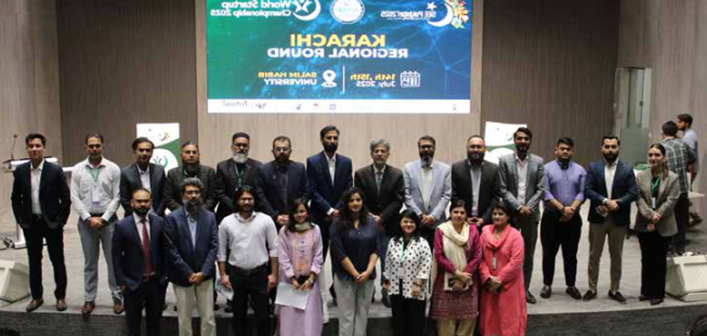
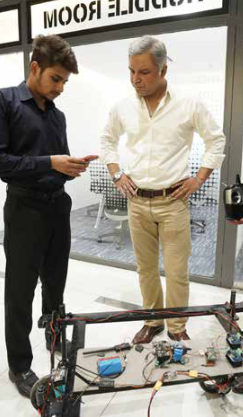
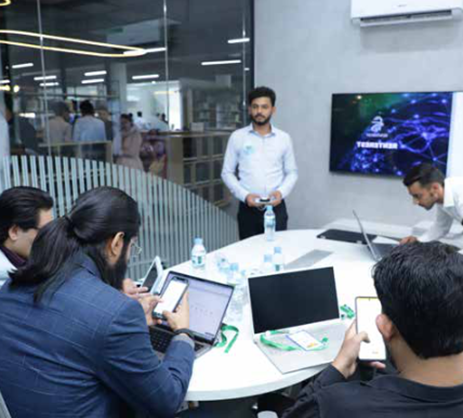
These are not ceremonial judges. They are practitioners — people who have built businesses, backed startups, and run incubators. They know what a viable startup looks like and what does not survive contact with the market.
The evaluation uses eight criteria, each scored on a scale of 1 to 5, for a total of 40 marks (Evaluation Forms WSC-SEE Pakistan, 2026):
- Solution — Does the proposed solution clearly address the identified problem?
Impact — Does the startup have the potential to create social, economic, or environmental impact, including job creation and contribution to the national economy?
- Value Proposition — Is the value proposition clearly articulated and achievable?
- Target Market — Is the target market logically chosen, with a clear understanding of trends and future market size?
- Revenue Model — Is there a clear understanding of cost and revenue drivers, with well-supported profitability assumptions?
- Team — Does the team have the experience and skills to commercialize the idea?
- Presentation Quality — Were the slides clear, conclusions reasonable, and was the presentation professional?
Growth Stage startups are evaluated on a deeper set of ten criteria for a total of 50 marks, including Solution impact, Market Share, Competitiveness, Financial Analysis, Worth, Customer Acquisition Cost, Sustainability, Team, Projections, and Exit Strategy (Evaluation Forms WSC-SEE Pakistan, 2026).
This is not a general impression score. Every criterion is defined. Every judge scores independently. The process removes subjectivity as much as possible.
Stage 4: Selecting the Judges
The quality of any evaluation depends entirely on the quality of the evaluators. SEE Pakistan handles this through a formal Judges Selection Evaluation Sheet — a structured scoring tool used to assess and select judges before they assess anyone else (WSC-SEE Pakistan Judges Selection Evaluation Sheet, 2026).
Proposed judges are scored out of 100 across nine criteria:
- Professional expertise in entrepreneurship, innovation, business, industry, investment, academia, incubation, or the startup ecosystem — 15 marks
- Direct experience with startups, founders, incubation centers, accelerators, or business mentoring — 15 marks
- Sector relevance with participating startups across technology, agriculture, health, education, climate, fintech, manufacturing, or social enterprise — 10 marks
- Prior evaluation experience in startup competitions, pitch sessions, business plan competitions, grants, or innovation challenges — 15 marks
- Assessment capacity to evaluate startups on innovation, market potential, scalability, financial viability, impact, and execution — 15 marks
- Communication skills and ability to ask relevant questions and provide constructive feedback — 10 marks
- Integrity and neutrality, including willingness to disclose conflicts of interest — 10 marks
- Availability and commitment to attend the full evaluation session — 5 marks
- Diversity contribution in terms of gender, region, sector, professional background, or ecosystem representation — 5 marks
The decision framework is equally clear. A score of 80 or above means the candidate is selected as a judge. A score of 70–79 places them on a reserve list. Below 70, they are not selected (WSC-SEE Pakistan Judges Selection Evaluation Sheet, 2026).
This is accountability built into the design. The people doing the judging are themselves judged before they walk into the room.
Stage 5: The Top 100 Announcement
Based on the regional evaluation results, the top 100 startups are selected and officially announced through social media (SEE Pakistan, 2026). This is a transparent, public announcement — the selection is not kept internal or revealed only on event day.
The announcement serves a purpose beyond celebration. It tells the broader ecosystem — investors, mentors, industry partners, and the media — exactly which startups are worth watching.
Stage 6: Bootcamps, Mentoring, and Networking
Selection into the top 100 is not the finish line. It is the beginning of the most intensive part of the journey.
The selected startups then participate in two days of bootcamps, covering training, mentoring, and networking opportunities (SEE Pakistan, 2026). By the time a startup reaches the final exhibition day, it has been evaluated twice, trained multiple times, mentored individually, and networked with investors and industry leaders.
This is what separates SEE Pakistan from a simple exhibition. It is a development program with a competitive finale.
Stage 7: The Final Exhibition and Prize
The process concludes with the final exhibition day. Startups evaluated by expert panels one last time. Winners receive prize money of up to USD 10,000 — the highest cash prize at any innovation expo in Pakistan (SEE Pakistan, 2026).
Since these top performers are connected to the World Startup Championship 2026, they will have access to international competition, global investor networks, and cross-border collaboration opportunities.
This is Blog 4 of the Knowledge Products Series: Innovative and Creative Pakistan. Previous blogs covered Pakistan’s Innovation Surge (Blog 1), the Growth Drivers — Pakistan’s Leading Innovation Hubs (Blog 2), and the SEE Pakistan Legacy (Blog 3).
References
- Evaluation Forms WSC-SEE Pakistan 2026. (2026). Ideation Stage and Growth Stage Evaluation Criteria — WSC 26 [Official evaluation instruments]. SEE Pakistan / APSUP / CMACED.
- SEE Pakistan. (2026). SEE Pakistan 2026 — World Startup Championship 2026 [Official website]. https://seepakistan.com.pk/
- WSC-SEE Pakistan Judges Selection Evaluation Sheet. (2026). Judges’ Selection Evaluation Sheet [Official selection instrument]. SEE Pakistan / APSUP / World Startup Championship 2026.