Executive Summary
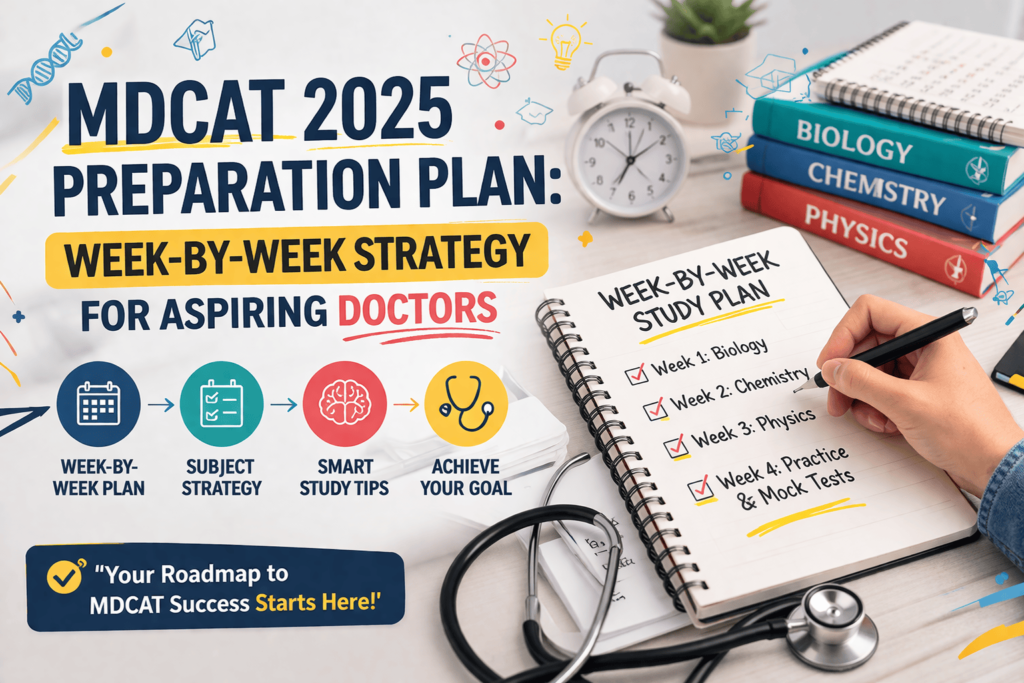
This comprehensive plan guides Pakistani pre-med (FSc/A-level) students through a 24-week MDCAT preparation timeline, with alternatives for shorter schedules. It incorporates official exam details (PMDC/UHS guidelines) and study strategies from coaching experts. Key elements include a subject-wise weekly study breakdown, daily/weekly hours, revision cycles, mock tests, time- and stress-management techniques, and exam-day tactics. Sample calendars (24-week and compressed 12-week), comparative schedules (intensive vs moderate), and resource tables (books, courses, question banks) are provided.
The approach emphasises active learning (e.g. flashcards, concept maps) and evidence-based techniques (spaced repetition, Pomodoro). Internal links to Superior University’s own MBBS admissions blog and external official sources (PMC/UHS) ensure accuracy and further reading.
Understanding the 2025 MDCAT Exam
The MDCAT 2025 is a national standardised paper-based MCQ test (180 questions in 3 hours) for MBBS/BDS admissions. It replaced the prior provincial format (2024 had 200 questions for each province) with a unified national exam administered by PMDC/UHS.
The official subject weightage is Biology 45% (81 MCQs), Chemistry 25% (45 MCQs), Physics 20% (36 MCQs), English 5% (9 MCQs), and Logical Reasoning 5% (9 MCQs). There is no negative marking, and UHS/PMDC set difficulty at roughly 15% easy, 70% moderate, 15% hard questions. Candidates must take the test in their province of domicile. Official guidelines stress using only PMC-approved material, noting UHS does not endorse any commercial prep courses or books.
Key official points: Familiarise yourself with the syllabus in the PMDC circular. The MDCAT is based on the FSc (Pre-Med) curriculum, so A-level students should cover FSc topics (via equivalence guides) to avoid gaps. Keep updated with PMDC/UHS notices for any changes.
Planning Your MDCAT Preparation: Timelines and Goals
Most successful candidates begin several months in advance. We assume a 24-week (6-month) timeline, but also outline an accelerated 12-week option if time is short. In both cases, the strategy is to balance content mastery with ongoing review and practice tests. For example, one MCAT-prep guide suggests dividing preparation into phases (roughly: 12 weeks of learning, 10 weeks of intensive practice, final revision). Similarly, we break the 24 weeks into segments: Phase 1 (weeks 1–12) for systematic coverage of all topics, Phase 2 (weeks 13–20) for deeper practice, and Phase 3 (weeks 21–24) for final revision and mock tests.
- Baseline test (Week 0): If possible, take a diagnostic full-length test to gauge your strengths and weaknesses.
- Phase 1 (Weeks 1–12): Cover the entire syllabus, roughly 3 subjects per week, integrating short daily revision.
- Phase 2 (Weeks 13–20): Focus on weak areas, accelerate practice MCQs, and ramp up full-length mock exams.
- Phase 3 (Weeks 21–24): Intensive revision: periodic topic reviews, final full tests each week, and light study on exam logistics.
At least one buffer week (or short breaks) should be built into each phase in case of holidays or unexpected events. If you have less time (e.g. 3 months), compress the schedule by increasing daily hours and reducing buffer days. Table 1 compares an Intensive 12-week plan with the Moderate 24-week plan in terms of study load and pacing.
| Plan | Duration | Daily Study Hours | Weekly Hours | Key Focus | Example Activities |
|---|---|---|---|---|---|
| Intensive | 12 weeks | 8–10 hours | 56–70+ hours | Rapid syllabus coverage, heavy practice tests | Focus on core topics each day; daily MCQ practice; multiple mocks. |
| Moderate | 24 weeks | 5–6 hours | 35–42 hours | Gradual learning + review cycles | Mix study + daily quizzes; weekly full-length mock tests; regular revisions. |
Table 1: Comparing intensive vs moderate preparation schedules. In general, the moderate plan (6–8 hrs/day) allows more breaks and review, while the intensive plan (10+ hrs/day) packs more into each week. Both plans should be structured: for example, one source suggests a daily schedule with 6 hours on Biology/Chemistry/Physics, plus 1 hour for English & LR, and 1–2 hours for revision or testing. Use time-management techniques (e.g. Pomodoro: 25 min study + 5 min break) to sustain focus.
Weekly Breakdown by Subject and Tasks
Below is a suggested week-by-week outline for the 24-week plan. Adjust order based on personal strengths or academic calendar (e.g. sync with school subjects). Each week, combine new content, MCQ practice, and a short review of previous material. Every 3–4 weeks, schedule a longer review week focusing on weak areas.
Weeks 1–4 (Foundations):
- Biology: Cell biology, biochemistry (enzymes, biomolecules), and genetics basics.
- Chemistry: Atomic structure, bonding, periodic table, basic stoichiometry.
- Physics: Kinematics, vectors, Newton’s laws, basic energy concepts.
- English: Daily practice of vocabulary (synonyms/antonyms), simple grammar rules.
- Logical Reasoning: Solve basic puzzles (series, analogies) to build familiarity.
Weeks 5–8 (Core Concepts):
- Biology: Molecular biology (DNA/RNA), evolution and ecology fundamentals.
- Chemistry: Chemical reactions, gas laws, thermochemistry.
- Physics: Work/energy, fluids, heat (thermodynamics).
- English: Intermediate grammar (tenses, voice, clauses) and comprehension.
- Logical Reasoning: Practice conditionals, syllogisms and data interpretation MCQs.
Weeks 9–12 (Advanced Topics I):
- Biology: Human physiology I (circulatory, respiratory, digestive systems).
- Chemistry: Organic chemistry I (hydrocarbons, functional groups introduction).
- Physics: Electricity & magnetism basics (current, circuits, fields).
- English: Advanced reading comprehension; essays/paragraph exercises.
- Logical Reasoning: Sequential patterns, cube counting, simple diagrams.
Weeks 13–16 (Advanced Topics II):
- Biology: Physiology II (nervous, endocrine systems), cell division & reproduction.
- Chemistry: Organic chemistry II (alkanes/alkenes, basic reactions).
- Physics: Waves, optics, sound.
- English: Unseen passages practice; more complex sentence structures.
- Logical Reasoning: Critical reasoning, paired conditions and more elaborate diagrams.
Weeks 17–20 (Intensive Practice & Weak Areas):
- Review all missed or weak topics across subjects.
- Daily full-length MCQ sets by subject (e.g., 60 Bio, 60 Chem, etc.).
- Mock Tests: Begin weekly timed full 180-Q tests (see below).
- Revision: Use flashcards/concept maps to revisit previous content rapidly.
Weeks 21–24 (Final Revision & Mocks):
- Revision: Systematic review of high-yield topics (hormones, optics formulas, grammar rules).
- Mocks: Take at least one full-length mock test per week under exam conditions. Analyse mistakes immediately (see Pitfalls below).
- Relaxation: In the last few days, focus on light review (summary notes) and rest.
Throughout, maintain daily/weekly review cycles: e.g., at the end of each week, recap key formulas/concepts, and on each weekend, solve past-paper MCQs from the week’s topics. Incorporate spaced repetition: briefly review older material every 1–2 weeks to enhance long-term retention. For example, flashcards or summary sheets can be revisited regularly.
Practice Tests and Revision Schedule
Regular testing is vital. Start with unit tests after finishing each major topic (e.g. a short Bio test after finishing genetics). As content coverage grows, schedule full-length mocks: many prep experts recommend one full-length simulated MDCAT every week (e.g. Sundays) once midway through your prep. This builds endurance and time management. Always use a timer (180 minutes for 180 MCQs, i.e. ~1 minute per question). After each mock, immediately review every incorrect answer and note the concept you missed. Keep an error log of mistakes and confuse-prone topics to revisit daily.
Revision Cycles: Plan mini-revisions every 3–4 weeks, where you step back from new content and cover previously studied material. Use techniques like concept maps or mnemonics to consolidate large topics. For example, teach a concept to a peer or out loud (the Feynman technique), make timelines for biology processes, and solve mixed MCQs from multiple subjects in one sitting.
Study Hours and Techniques
The quality of study beats sheer quantity. Aim for focused study sessions of 25–50 minutes, with short 5–10 minute breaks in between. Techniques backed by cognitive science include active recall (e.g. flashcards, self-quizzing) and dual coding (combining diagrams with text). For example, use flashcards to memorise definitions and then practice recalling them without looking. When revising complex topics (e.g. physiology, organic reactions), draw concept maps or flowcharts to link ideas visually.
Spaced repetition is key: repeatedly quiz yourself on the same material at increasing intervals (daily, then every few days, then weekly) to move knowledge into long-term memory. According to educational research, distributing review over time (rather than cramming) significantly improves retention.
Example weekly schedule (moderate timeline):
– Mon-Fri: 5–6 hours/day (3–4h on science, 1h on English/LR, 1h review/Qs). Use evenings or early mornings if needed.
– Weekends: 6–8 hours/day. Include one full mock test on the weekend, a lighter session of grammar or puzzles on the other day.
– Daily routine: Start with your weakest subject in the fresh morning, alternate topics each session to avoid fatigue, and end with reading or lighter material (e.g. English/LR) as a wind-down.
Managing Time and Stress
Time management: Create a detailed timetable with fixed study slots. Use planners or apps to block study times. Stick to your schedule as much as possible; regularity beats sporadic marathon sessions. One coach advises: “Follow a study schedule: divide the day into core study, revision, and practice times.” Monitor actual vs planned hours each week to adjust as needed. Use tools like Pomodoro (25 min study/5 min break) to boost concentration. Avoid multitasking – study one topic at a time.
Stress and health: High-stakes exam prep can be stressful. Balance study with adequate sleep (7–8 hours), nutrition, hydration, and light exercise. As one expert notes: “Every strategy for getting good grades should include enough sleep, eating well, and mental health breaks”. Schedule short breaks (5–10 min) every hour and longer breaks or one day off weekly to recharge. Mindfulness or breathing exercises can reduce anxiety during crunch periods. Remember to maintain hobbies or social time in small doses to prevent burnout.
Exam-Day Strategy
On test day, arrive early at the centre with all required documents (admit card, CNIC, etc.) and permitted items (calculator is not allowed, so memorise key formulas!). Dress comfortably, bring water and snacks. During the exam: quickly scan through the sections in order – it’s often best to tackle Biology and Chemistry first (higher weight) while fresh, then Physics, then English/LR. Keep strict time checks (about 1 minute per question); if stuck, mark and move on, returning if time remains.
Because there’s no negative marking, it’s advantageous to attempt all questions (making educated guesses if needed) rather than leave blanks. Answer easy questions first to secure marks and build confidence, then spend extra time on tougher ones. For English, read the passage questions BEFORE the passage to focus your reading. For logical reasoning, practice data interpretation or puzzles to improve speed. Save 5–10 minutes at the end for a rapid review of your answers if possible. Maintain calm; trust your preparation.
Common Pitfalls to Avoid
- Skipping syllabus topics: Do not ignore any section of the syllabus. Ensure coverage of all FSc topics (many repeated MDCAT questions come from A-level or IB syllabus, but the core is FSc). A-level students should especially review FSc board books and past papers.
- Last-minute cramming: Cramming is less effective than spaced study. Studying 1 hour/day for 30 days beats a 30-hour cram session. Start early and follow the plan.
- Neglecting weak subjects: Regularly practice all five subjects. Students often focus on Biology and neglect English or Logical Reasoning. Yet even though English/LR are only 18 MCQs, they can make the difference for top merit. Allocate daily or weekly slots to vocab, grammar, and reasoning puzzles.
- Over-reliance on one resource: Use a mix of textbooks (FSc Part I/II), coaching notes, and MCQ books. High-quality practice materials (see Resources below) cover varied question styles. Avoid unverified “short notes” that may have errors.
- Ignoring official guidelines: Read the PMDC/UHS instructions carefully. For example, you must test in your home province; ID and calculator rules are strict.
Resources and Links
Key Resources:
– Official syllabus and guidelines: PMDC’s Uniform MDCAT 2025 curriculum (downloadable from the PMDC site) and the UHS MDCAT-2025 Information Guide. Bookmark the PMDC and UHS portals for updates.
– Textbooks: FSc (Biology, Chemistry, Physics) Part I & II textbooks (any Punjab/Sindh/KPK editions) are primary references. Many questions mirror board exam topics. For English and LR, high-school English grammar books and puzzle books help.
– Coaching Books: Dogar Brothers’ MDCAT series is popular:
– MDCAT Video Lectures Book (integrates book material with Tabir online videos).
– MDCAT Practice Tests Book – full-length timed tests.
– National MDCAT Solved Past Papers – previous years’ papers fully solved.
These align with the latest syllabus and include graded MCQs with explanations.
– Online Question Banks: Virtual University’s Entry Test MCQ bank (free online), AIU MDCAT preparation apps and academy sites like PrepByPMS or MDcatMaster offer chapter-wise quizzes.
– Past Papers: Solve past MDCAT papers (NUMS, UHS, KMU) from 2018–2024. UHS often publishes solved keys; for example, one can find UHS 2024 paper PDFs online. Practising past papers familiarises you with the question format and repeats.
Online Courses & Lectures:
– KIPS Preparations (online/offline courses) – known for organised lectures (check kipsprep.com).
– Step by PGC (pgc.edu) – offers video courses and test series.
– YouTube channels – e.g. Crash Course Biology (for basics), Khan Academy Chemistry/Physics (free concept videos), local coaches like Agha Saad, Ali Awad, etc.
– Superior University Internal Link: Superior’s own blog covers related topics like MBBS admissions and alternative paths, which can complement your research on medical careers.
Recommended Tools:
– Study Apps: Quizlet (flashcards), Anki (spaced repetition cards), Pomodoro timers (Forest, Be Focused).
– Planners: Printable study calendars or apps (Google Calendar, Trello) for scheduling.
Visual Plan Examples
To illustrate, the 24-week timeline below shows major milestones and study phases. You might draw a similar timeline in your planner. (Legend: Study Phase spans multiple weeks, Mock Tests arrows indicate practice tests).
Image: Example study plan timeline – break long-term preparation into phases and weekly goals.
(Figure: Study plan timeline with phases for new learning, mock tests, and final revision.)
Additionally, here is a sample weekly calendar snippet for an intensive 12-week plan vs a moderate 24-week plan:
- 12-Week (Intensive): Mon–Sat 9 am–5 pm study blocks (Bio, Chem, Phys rotate), Sunday full mock test.
- 24-Week (Moderate): Mon–Fri 5 pm–8 pm, Sat 10 am–4 pm, with one mock on Sunday.
These can be adapted to your daily routine.
Exam Day and Final Tips
- Final week: Light revision only (flashcards, summarised notes). Avoid new topics at the last minute. Rest well.
- Health: Maintain good sleep, nutrition, and light exercise right up to the exam.
- Mindset: Stay confident. Remind yourself of past successes (good scores on mocks). Use positive self-talk.
- Time use: In the exam, do easier sections first to secure marks, then tackle harder ones. Since there’s no penalty for wrong answers, attempt everything (never leave questions blank). Manage one’s time strictly (e.g. 2 Bio MCQs in ~1 min, etc.).
Suggested Internal/External Links
- Superior University MBBS Admission Blog – explains why MDCAT matters for college admission (internal context).
- PMDC/UHS official MDCAT pages (for syllabus and registration).
- Coaching academy blogs (e.g. Tabir Academy’s preparation guides, PreachBio tips).
- Educational resources (NCAT strategy guides, cognitive study tips).
References: Official MDCAT curriculum[1][6], UHS exam guide; study tips and plans from coaching experts[19][2] and academic sources[10][11][9]. All material is tailored to the Pakistani pre-med context.