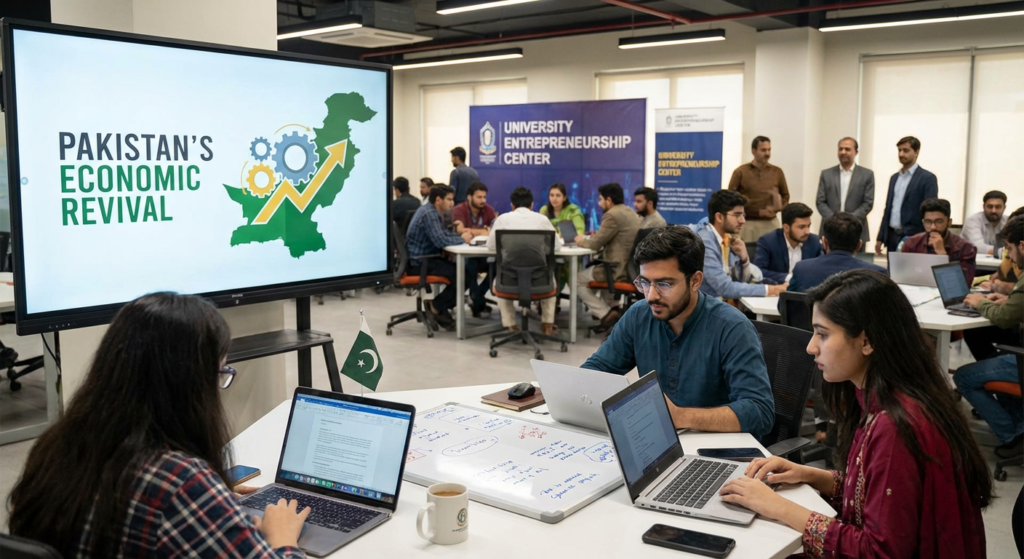
Pakistan is facing serious economic challenges. Rising unemployment, inflation, and limited job opportunities are major concerns for students and parents. According to economic data, small and medium enterprises (SMEs) already employ nearly 78% of Pakistan’s non-agricultural workforce. This shows that businesses, especially small startups, are the backbone of our economy.
When more startups are created, more jobs are created. When jobs increase, families become financially stable. This is why Entrepreneurship in Pakistan is not just a trend; it is a national need.
Entrepreneurship helps:
- Create new jobs
- Solve local problems
- Increase exports
- Promote innovation
- Strengthen the national economy
Universities now play a very important role in this transformation.
Understanding the Startup Ecosystem in Universities
A startup ecosystem includes entrepreneurs, mentors, investors, universities, and industry partners working together. Research shows that universities play a powerful role in developing innovation and talent.
In Pakistan, startup ecosystem universities are becoming growth engines. They provide:
- Entrepreneurship education
- Business incubation centers
- Industry connections
- Investor access
- Mentorship programs
Among these institutions, Superior University stands out for its structured and practical approach toward entrepreneurship.
Superior University Entrepreneurship: A Vision Beyond Degrees
Superior University believes students should become job creators instead of job seekers. This mindset is central to Superior University entrepreneurship.
The university has built a complete entrepreneurial ecosystem that connects education with real market exposure. Their focus is not only on teaching theory but also on building businesses.
Their mission is simple:
“Equip students with skills, exposure, and support to launch successful ventures that contribute to Pakistan’s economy.”
Innovation District 92 – The Heart of Superior’s Startup Ecosystem
One of the most important initiatives at Superior is Innovation District 92 (ID-92).
This is the university’s startup incubator where student ideas are transformed into real businesses.
What ID-92 Offers:
- Office space and labs
- Expert mentorship
- Networking with industry leaders
- Investor connections
- Pitch training
- Acceleration support
Through ID-92, many student startups have secured funding and generated revenue. Some ventures have even represented Pakistan internationally.
This shows how Superior University entrepreneurship is directly contributing to economic revival.
The 3U1M Program: Bridging Education and Industry
Superior introduced an innovative model called 3U1M (Three Years in University, One Year in Market).
In this structure:
- Students study for three years
- The final year is spent in the industry or working on startups
This model reduces the gap between education and employment. Students graduate with:
- Real experience
- Professional networks
- Business understanding
- Market exposure
This practical approach strengthens the startup ecosystem within universities.
CMACED – Training Entrepreneurial Mindsets
Superior also established the Chaudhry Muhammad Akram Center for Entrepreneurship Development (CMACED).
CMACED focuses on:
- Design thinking
- Problem solving
- Leadership development
- Business model creation
It trains students to identify problems and convert them into opportunities.
This structured support system ensures that students are not left alone after having an idea they are guided step by step.
Industry Partnerships That Strengthen the Ecosystem
Superior University understands that entrepreneurship cannot grow in isolation. That is why it builds partnerships with industry leaders.
For example, ID-92 partnered with Conatural as a Platinum Partner to provide mentorship and practical exposure to startups.
Such partnerships:
- Increase credibility
- Provide industry insight
- Help startups refine products
- Open doors for investment
This strengthens the Entrepreneurial Ecosystem mentioned in the university’s metadata.
How Superior’s Ecosystem Contributes to Pakistan’s Economy
The impact of Superior University entrepreneurship can be seen in multiple ways:
1. Job Creation
Graduates either secure quality employment or create startups that employ others.
2. Innovation
Students are building solutions in technology, agriculture, health, and services.
3. Investment Attraction
Incubated startups have generated millions in revenue and investments.
4. Youth Empowerment
Students develop confidence, leadership, and financial independence.
When universities create entrepreneurs, they reduce pressure on government jobs and contribute to sustainable economic revival.
Why This Matters for Pakistani Parents and Students
Parents often worry about:
- Job availability
- Career security
- Financial stability
Superior University provides a structured system that reduces uncertainty. Students are guided from idea generation to market launch.
Instead of waiting for opportunities, students are trained to create opportunities.
This is the future of education in Pakistan.
The Future of Entrepreneurship in Pakistan
Pakistan has a young population. More than 60% of the population is under 30 years old. If properly trained, this youth can become the driving force of economic growth.
Universities must continue to:
- Encourage innovation
- Provide incubation support
- Build industry partnerships
- Offer practical exposure
Superior University is already playing this leadership role through its entrepreneurial ecosystem.
If more institutions adopt similar models, Pakistan’s economic revival can accelerate significantly.
Frequently Asked Questions (FAQs)
- How does entrepreneurship benefit Pakistan’s economy?
Entrepreneurship creates jobs and solves local problems. Most Pakistani businesses are SMEs employing around 78% of the non-farm workforce. New startups can add jobs on top of that. Experts note that in the face of high unemployment, raising entrepreneurship is crucial because “new businesses can generate jobs and increase purchasing power”. Each new company helps circulate money in the economy. - What role do universities like Superior play in the startup ecosystem?
Universities educate talent and drive innovation. Superior University, for example, calls itself a “catalyst for Pakistan’s knowledge economy,” because it combines academic learning with real business projects. Its incubator (ID-92) connects students with mentors and investors, helping ideas become businesses. Research shows higher education institutions are key to an entrepreneurial ecosystem – they “develop talent and promote innovation”. In short, universities supply the trained people, research and networks that startups need. - What is Innovation District 92 (ID-92), and who can apply?
Innovation District 92 is Superior University’s startup incubator. It runs regular cohorts (recently, the 13th was announced) to take student projects to market. Any Superior student or graduate with a viable idea can apply. To join ID-92, you submit your business idea for review. If selected, you get dedicated office space, lab facilities, mentoring and pitch preparation. ID-92 effectively guides student teams in turning ideas into companies. - Does Superior University fund student startups?
No, the university itself does not invest money in startups. Instead, it teaches students how to secure funding from outside sources. As the university states, it “prepares you to attract investors and connects you with funding networks,” rather than directly funding ventures. In practice, this means students learn to make strong pitches, and ID-92 helps them meet angel investors or apply for grants and accelerators. - What is the 3U1M program at Superior University?
The 3U1M (Three Years in University, One Year in Market) program is a special degree structure. Students spend the first three years on campus learning their major, then the fourth year working full-time in industry or on a startup project. This gives them hands-on experience, contacts, and a portfolio of work before graduating. The idea is to eliminate the gap between college and the real world, so every student leaves ready for a career or entrepreneurship.